


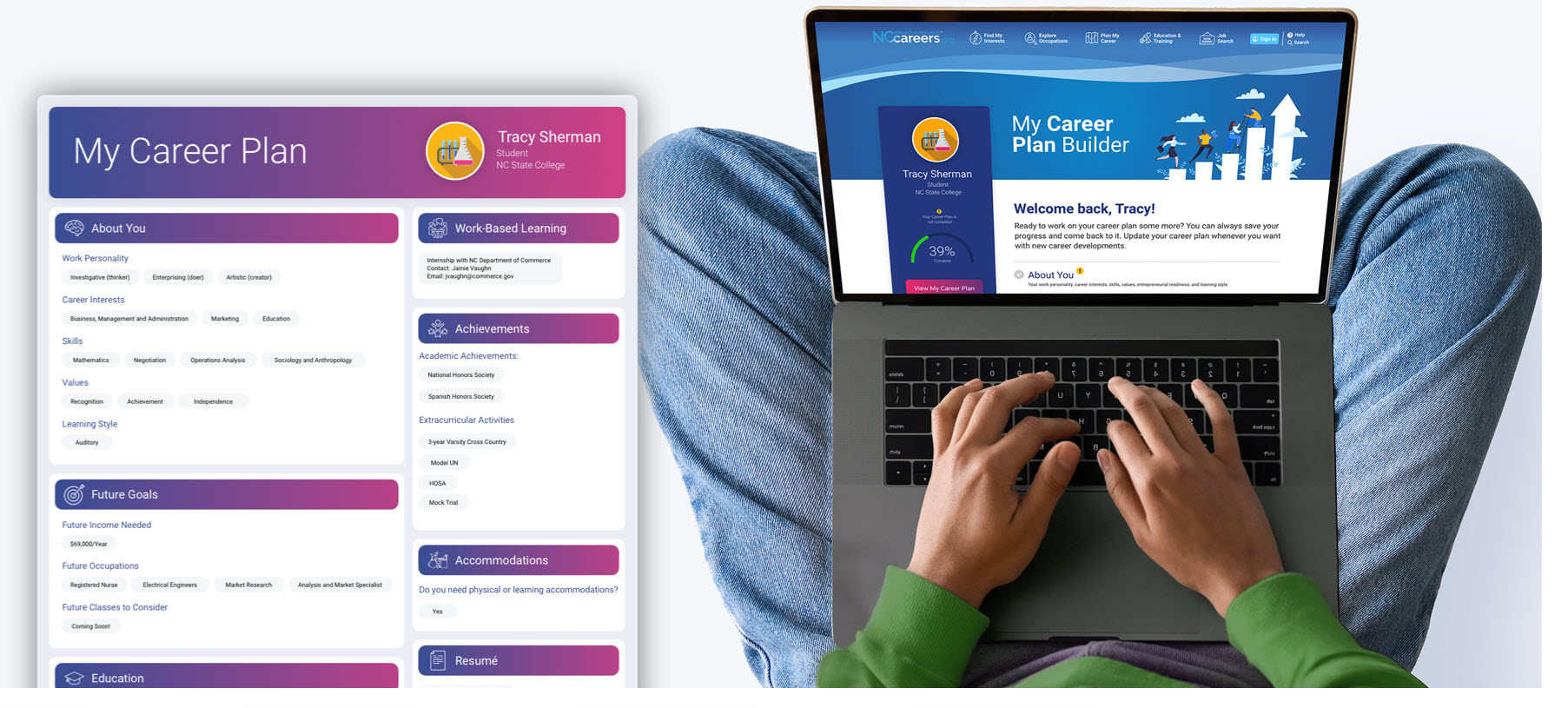
 NCcareers.org now offers you a personal career GPS! Map your path to success with our Career Development Builder. This personalized platform assesses your unique skills and aspirations, providing a step-by-step roadmap to your dream career. Update your goals, track your progress, and access targeted resources - all in one place.
 Sign in and start building your Career Plan now!
Need some help getting started? Review our Quick Start Guide (coming soon)
Review the Career Plan Frequently Asked Questions
Next Step
Start building your future career today.

By Education (What Can I Do With My Education)
Use your education as a starting point in your journey. Choose a type of education and search for a program to see which occupations best match your education. Click the add education button if you want to include additional education types.

By Current Occupation (Next Step)
Use your current job or any occupation you desire as the starting point in your career journey. Type in an occupation name to learn what is next in line on your career journey.

By Goal Career (First Step)
This tool can help you understand a potential pathway to a goal career. First start with your goal career. Next, add a starting education or occupation. Now start building. You'll then be presented below with jobs that have similar job skills or job duties to your dream job but typically pay less.
First Step





Education: Bachelor's degree
Bachelor's degree
Median Annual Wage
$68,240
($32.81/hr)
Annual Growth Rate
Strong Growth
1.3%
Avg. Annual Openings
Average Opportunity
178
Choose your next step from the list below by dragging the Occupation into your Career Journey above.
Sort By
12
Education
Requirement
Requirement
Median
Annual Wage
Annual Wage
Annual
Growth Rate
Growth Rate
Avg. Annual
Openings
Openings

Education: Associate's degree
Associate's degree
Median Annual Wage
$47,860
($23.01/hr)
Annual Growth Rate
Very Strong Growth
1.5%
Avg. Annual Openings
Average Opportunity
125
Education: Bachelor's degree
Bachelor's degree
Median Annual Wage
$64,200
($30.87/hr)
Annual Growth Rate
Very Strong Growth
1.4%
Avg. Annual Openings
Few Opportunities
35

Education: Bachelor's degree
Bachelor's degree
Median Annual Wage
$65,800
($31.64/hr)
Annual Growth Rate
Strong Growth
1.3%
Avg. Annual Openings
Strong Opportunity
367
Education: Bachelor's degree
Bachelor's degree
Median Annual Wage
$46,050
($22.14/hr)
Annual Growth Rate
Strong Growth
1.2%
Avg. Annual Openings
Strong Opportunity
383
Education: Bachelor's degree
Bachelor's degree
Median Annual Wage
$61,820
($29.72/hr)
Annual Growth Rate
Strong Growth
1.1%
Avg. Annual Openings
Few Opportunities
32
Education: Bachelor's degree
Bachelor's degree
Median Annual Wage
$61,930
($29.78/hr)
Annual Growth Rate
Slow Growth
0.6%
Avg. Annual Openings
Few Opportunities
33
Education: Associate's degree
Associate's degree
Median Annual Wage
$48,910
($23.51/hr)
Annual Growth Rate
Slow Growth
0.6%
Avg. Annual Openings
Few Opportunities
73
Education: Associate's degree
Associate's degree
Median Annual Wage
$45,570
($21.91/hr)
Annual Growth Rate
Slow Growth
0.3%
Avg. Annual Openings
Average Opportunity
88
Education: Bachelor's degree
Bachelor's degree
Median Annual Wage
$70,320
($33.81/hr)
Annual Growth Rate
Slow Growth
0.3%
Avg. Annual Openings
Rare Opportunity
23

Education: Bachelor's degree
Bachelor's degree
Median Annual Wage
$45,670
($21.96/hr)
Annual Growth Rate
Slow Growth
0.1%
Avg. Annual Openings
Few Opportunities
53
Education: Bachelor's degree
Bachelor's degree
Median Annual Wage
$$$
No Data Available
Annual Growth Rate
Slow Growth
0.1%
Avg. Annual Openings
Rare Opportunity
11

Education: Master's degree
Master's degree
Median Annual Wage
$62,570
($30.08/hr)
Annual Growth Rate
None or Negative Growth
%
Avg. Annual Openings
Rare Opportunity
8


Save
Start Planning
Middle and High School is the perfect time to start thinking about careers. Learn about the advantages of thinking about careers at a young age.
Career development and Career and Technical Education (CTE) courses help you plan and gain skills for success in your future career. Learn about CTE, Internships, and more from your CDC.
Learn about the services and assistance your school counselor provides and how they can help you with your career planning.
Gain skills and career experience through CTE. Learn about courses, clusters, work-based learning, student organizations (CTSOs), NTHS, industry credentials, free college courses and more.
Learn about how these NC Community College staff members can help.
NCWorks has programs that can help with career planning and more…